You are talking every day. You spend weekends together. You know what coffee they order, what makes them anxious, what their mother is like, and which side of the bed they sleep on.
But ask what the relationship actually is?
Suddenly, nobody knows.
That blurry space between casual dating and an established relationship has become so familiar that we now have a word for it: the situationship.
And although the word can sound like internet slang, there is increasingly real research behind the phenomenon.

Situationships Are Not Nearly as Unusual as They Feel
One of the strangest things about being in an undefined relationship is how isolating it can feel.
You can spend months wondering whether you are being unreasonable for wanting clarity, while quietly assuming everyone else has somehow mastered modern dating.
The numbers suggest otherwise.
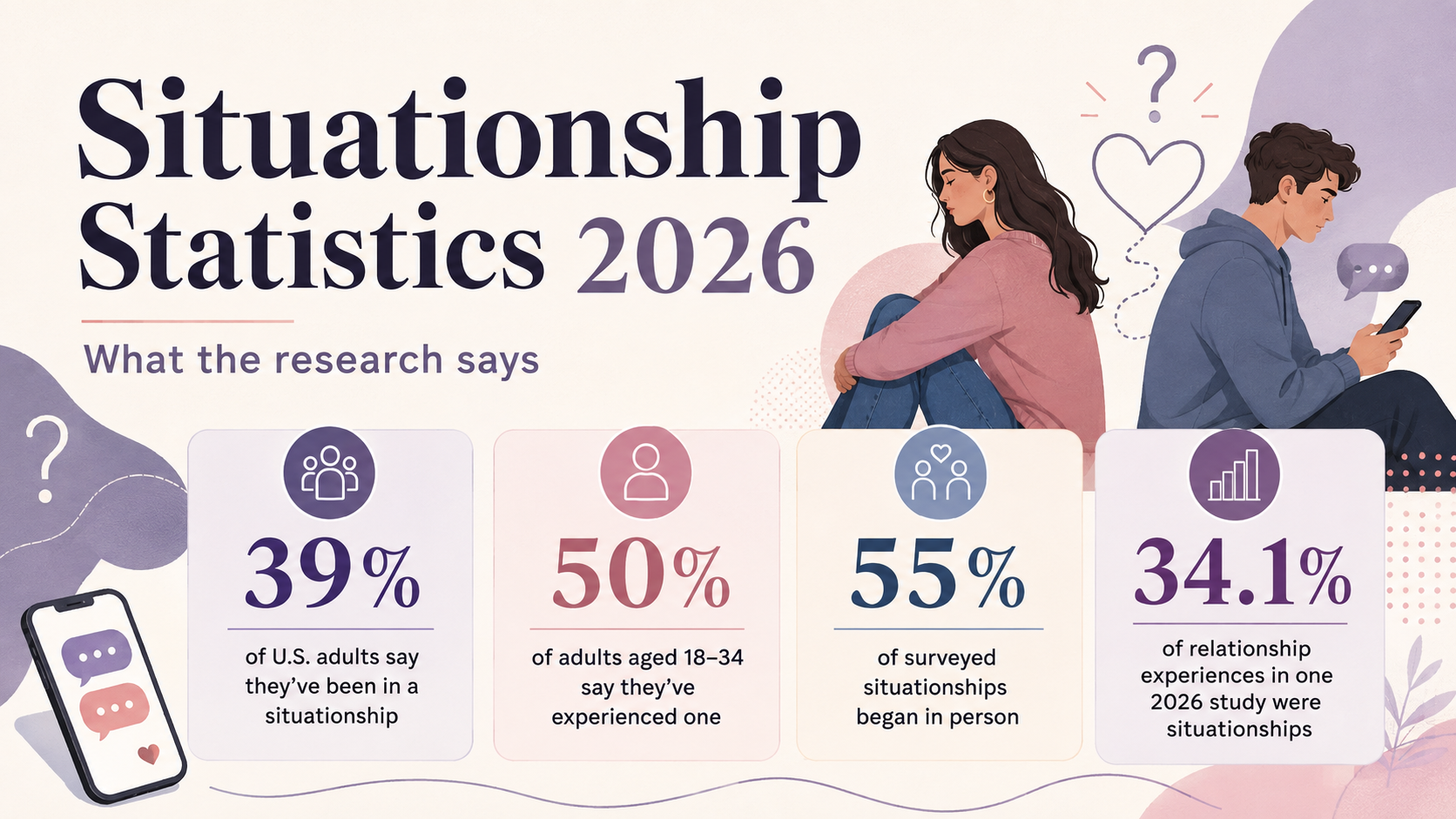
According to Left Unsaid’s review of current situationship statistics and research, a 2024 YouGov survey found that 39% of U.S. adults said they had experienced a situationship.
Among adults aged 18 to 34, that figure rose to 50%.
That does not mean half of young adults are currently in one. It means half of the younger adults surveyed said they had experienced one at some point.
Still, that is a remarkably large number for a relationship category that barely had a mainstream name a decade ago.
And No, They Do Not All Begin on Dating Apps
I had assumed situationships were mostly the offspring of Tinder, Hinge and endless late-night messaging.
Apparently not.
Left Unsaid’s research summary reports that the same YouGov survey found 55% of reported situationships began through an in-person connection.
Social media accounted for another 17%, while dating apps accounted for 7% among adults overall.
Among younger adults, social media played a much larger role.
That makes sense when you think about it.
A situationship does not require an app. It only requires two people to become emotionally or physically involved while leaving the structure of the relationship unclear.
That can happen with a coworker, a friend, someone you met through university, someone you already knew socially, or someone who gradually became much more than a friend without either person ever naming the transition.
The Real Issue Is Not the Label. It Is the Ambiguity.
There is nothing inherently unhealthy about two adults deciding that they do not want a conventional committed relationship.
The problem begins when the two people are not actually operating from the same understanding.
One thinks:
We are taking things slowly.
The other thinks:
This is casual and always will be.
One assumes exclusivity.
The other assumes freedom.
One is becoming increasingly attached.
The other is deliberately avoiding defining anything.
That is why the distinction between a situationship and a relationship is about more than whether somebody has used the words boyfriend or girlfriend.
It is about expectations, commitment, communication and whether both people understand the relationship in roughly the same way.

Research Is Starting to Look at Trust Too
This is where the academic research becomes particularly interesting.
One 2026 study examined 261 emerging adults who reported on 468 romantic relationship experiences.
About 34% of those relationship experiences were classified as situationships.
The researchers found that situationship status was associated with lower trust in the partner and lower perceived trust from the partner across several communication contexts.
That does not prove situationships cause distrust.
But it does fit something many people recognise emotionally: it is difficult to feel completely secure when you do not know what rules the relationship is operating under.
You can communicate constantly and still not know where you stand.
You can receive good-morning texts every day and still wonder whether they would describe themselves as single.
You can spend three nights a week together and still be afraid to ask whether they are seeing somebody else.
Why Does an Undefined Relationship Sometimes Feel More Intense?
Logically, you might expect a casual relationship to hurt less.
Emotionally, the opposite can happen.
When something is uncertain, we tend to pay more attention to it.
Every affectionate message feels important.
Every delay feels suspicious.
Every amazing weekend seems like evidence the relationship is progressing.
Every cold spell makes you wonder whether it is ending.
The result is a relationship that can feel astonishingly emotionally loud despite never becoming officially defined.
Left Unsaid has an excellent explanation of why situationships can feel so intense, particularly when uncertainty, attachment and intermittent reassurance become mixed together.
The Most Important Question May Be Whether You Both Want the Same Thing
I think we sometimes become so focused on decoding another person’s behaviour that we forget to ask the simpler question.
Does this relationship actually work for me?
Not:
Could it eventually become something?
Not:
Do they secretly care more than they admit?
Not:
What did that message mean?
But:
If nothing changed, would I still want this relationship six months from now?
That question cuts through an enormous amount of romantic noise.
If both people genuinely want something casual, undefined and low-commitment, there may be no problem to solve.
If one person wants a relationship while the other wants access without commitment, then the ambiguity itself becomes part of the problem.
Research Can Give Context. It Cannot Make the Decision for You.
This is probably the most useful thing I took from reading the statistics.
The numbers can tell you that situationships are common.
They can show that many other people have experienced the same strange combination of intimacy and uncertainty.
They can tell researchers something about trust, communication and emotional experience across groups.
But they cannot tell you whether the person sitting across from you will eventually commit.
They cannot tell you whether waiting another three months will change anything.
And they cannot tell you whether you should stay.
For that, you have to look at the relationship itself.
If you are trying to understand the bigger pattern, the complete Left Unsaid Situationships Guide brings together the research, signs, mixed signals, commitment questions, endings and recovery in one place.
And if you are still wondering whether what you are experiencing even counts as one, start with what a situationship actually is and the signs you may be in one.
One Last Thought
Maybe the most revealing thing about situationships is not that modern dating has invented some completely new kind of human relationship.
People have always become attached without knowing whether the other person wanted the same future.
What has changed is that we finally have a widely recognised word for the grey area.
And once something has a name, it becomes easier to research.
More importantly, it becomes easier to ask yourself whether that grey area is somewhere you actually want to live.