
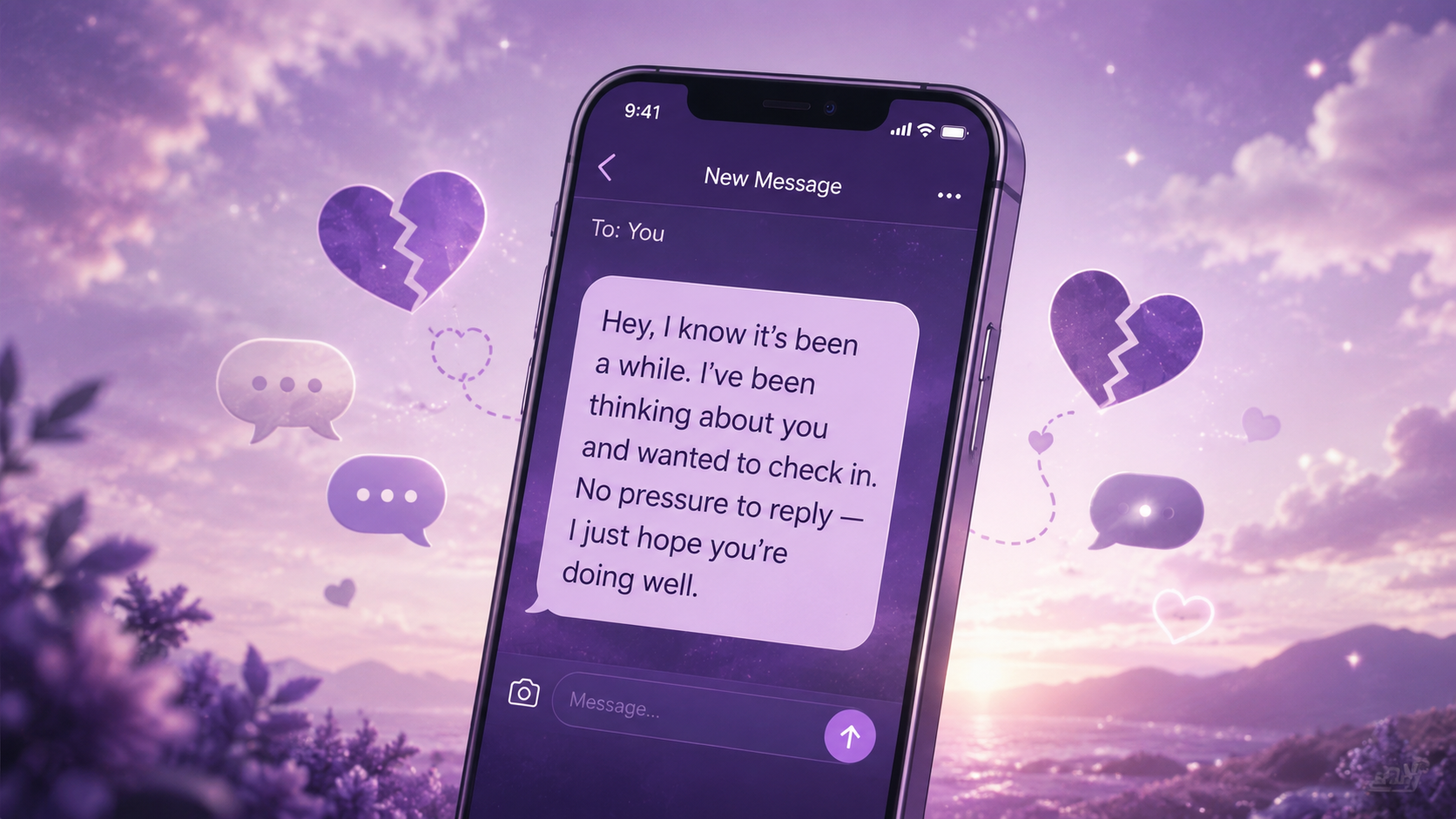
At first, it is only three words.
“I miss you.”
Then it becomes a paragraph. You explain that you have been thinking. You mention a memory you know will matter to them. You try to sound warm but not desperate, honest but not overwhelming, hopeful but not too obvious.
You read it one more time and wonder whether this could be the message that changes everything.
After a breakup, it is easy to believe that the right words might reopen a door that seems to have closed. You imagine your ex reading the message, remembering the best parts of the relationship, and suddenly seeing the breakup differently.
Sometimes a message can begin a real conversation.
But no text can guarantee reconciliation, and the messages most likely to create healthy contact are rarely the dramatic ones.
The Search for the Perfect Message
When you are hurting, the idea of finding the perfect message can feel comforting.
It gives you something to do. Instead of sitting with the uncertainty of the breakup, you can focus on wording, timing and strategy.
You begin searching for texts to get your ex back, hoping someone else has already discovered the sentence that makes an ex reconsider.
Perhaps it should be emotional.
Perhaps it should remind them of a happy memory.
Perhaps you should sound as though you are moving on so they become afraid of losing you.
The problem is that relationships rarely end because one perfect sentence was missing.
A breakup usually grows from deeper issues: unmet needs, repeated conflict, lost trust, incompatible goals, emotional distance or patterns that became too painful to continue.
A message may open communication, but it cannot solve all of that by itself.
What Do You Want the Text to Do?
Before sending anything, ask yourself what you hope will happen.
Do you want to apologise?
Do you want to know whether they are open to speaking?
Do you want them to reassure you that they still care?
Or are you hoping the message will create such a strong emotional reaction that they immediately ask to come back?
These are very different goals.
A message written to invite an honest conversation will sound different from one written to force reassurance. One respects the other person’s freedom to choose. The other tries to manage their feelings from a distance.
The first can create clarity.
The second usually creates more anxiety.
The Message You Write at Midnight
Late-night messages often contain everything you managed not to say during the day.
Loneliness becomes urgency. Missing them becomes proof that you should act. The silence begins to feel unbearable, and sending something seems easier than continuing to wonder.
This is often when you begin drafting a long text to get your ex back.
You explain how much you have changed. You promise the relationship would be different. You describe how empty life feels without them. You may even remind them of every beautiful thing you shared.
Those feelings can be genuine.
But genuine emotion does not always create a message that is easy to receive.
A long emotional text can place pressure on your ex to respond immediately, comfort you or make a decision before they are ready. It may communicate pain clearly while making calm conversation more difficult.
Writing the message can still help. You simply do not have to send the first version.
Save it. Sleep. Read it again tomorrow.
Often, the message you need to write and the message you should send are not the same message.
Do Not Try to Manufacture Missing You
Some advice suggests making your ex jealous, pretending to have moved on or using carefully calculated silence to create fear.
These tactics may produce a reaction, but a reaction is not the same as reconciliation.
Your ex may respond because they feel threatened, curious or temporarily lonely. That does not mean the issues behind the breakup have changed.
If the relationship restarts through anxiety and manipulation, those feelings tend to follow it back in.
Healthy reconnection does not begin with making someone afraid.
It begins with honesty, accountability and the freedom for both people to decide what they genuinely want.
A Better First Message
If enough time has passed, your ex has not asked for no contact, and there is no history of abuse or repeated boundary violations, a short and respectful message is usually better than an emotional speech.
For example:
“Hi. I have had some time to reflect on how things ended, and I recognise my part in what happened. I do not want to pressure you, but I would be open to a calm conversation if you ever feel the same.”
This message does not demand an answer.
It does not promise that everything has changed overnight.
It acknowledges responsibility while leaving the other person room to choose.
That room matters.
When an Apology Is Appropriate
An apology can be meaningful when it is specific.
“I am sorry for everything” may sound heartfelt, but it can also avoid naming what actually happened.
A clearer message might be:
“I have been thinking about how dismissive I became during difficult conversations. You were trying to tell me what you needed, and I often defended myself instead of listening. I am sorry.”
A real apology does not immediately ask for the relationship back.
It does not contain a hidden demand for forgiveness.
It shows that you understand the impact of your behaviour, whether or not reconciliation follows.
This can make future conversation safer, but it still does not obligate your ex to return.
What Has Actually Changed?
Before telling your ex that things would be different, ask yourself what “different” means.
Have you understood the pattern that damaged the relationship?
Have you changed anything beyond feeling frightened by the loss?
Would you communicate differently during conflict?
Have you addressed jealousy, avoidance, dishonesty or emotional unavailability?
Wanting the pain to stop can feel like personal transformation. It is not always the same thing.
Change becomes believable when it is visible in your behaviour, not only described in a message.
If you tell your ex that you have changed, be prepared to explain calmly what you now understand and what you are doing differently.
Keep the First Contact Small
The purpose of an opening message is not to settle the entire relationship.
It is simply to discover whether respectful communication is possible.
Keep it short enough that your ex can read it without feeling trapped inside your emotions. Avoid sending several follow-up messages because they have not replied quickly.
People may need time to decide how they feel about contact.
If they are open to talking, a deeper conversation can happen later. Trying to explain every feeling in the first message can make the situation feel heavier than it needs to be.
What Not to Send
Avoid messages designed to create guilt.
“I guess I never meant as much to you as you meant to me.”
Avoid emotional ultimatums.
“This is your last chance to fix things.”
Avoid pretending there is an emergency just to make them respond.
Avoid sending a casual message when your real intention is hidden.
“Hey, I just found one of your socks.”
If the sock is not the real reason you are contacting them, the conversation begins with avoidance.
You do not need to reveal every feeling immediately, but your message should not be a trap.
Prepare for Every Kind of Response
Before sending the message, imagine several outcomes.
Your ex may respond warmly.
They may respond politely but make it clear that they do not want to revisit the relationship.
They may not respond at all.
They may ask for more space.
If only the first outcome feels emotionally survivable, you may not be ready to send the text.
Contact gives you the ability to express yourself. It does not give you control over the answer.
The more you can accept that before sending anything, the less likely you are to become trapped in repeated messages, explanations and attempts to change their mind.
When You Should Not Send Anything
Do not send a message if your ex has clearly asked you not to contact them.
Do not send one if they have blocked you and you are considering using another number or account.
Do not reach out repeatedly after receiving no answer.
Do not send a reconciliation message when you are intoxicated, highly distressed or unable to tolerate rejection.
And if the relationship involved abuse, intimidation, stalking or serious emotional harm, reconnecting may not be safe or healthy.
Missing someone does not automatically mean contact is good for you.
Three Respectful Message Examples
When you want to apologise:
“I have reflected on how I handled the end of our relationship, and I am sorry for the hurt I caused. I do not expect anything from you, but I wanted to take responsibility honestly.”
When you want to ask whether they are open to talking:
“Hi. I hope you are doing okay. I have had some time to reflect and would be open to a calm conversation about us. There is no pressure to reply if that is not something you want.”
When the breakup was mutual but you think reconciliation may be possible:
“I have been thinking about our relationship and the reasons it ended. I still care about you, but I also understand that caring is not enough without change. Would you be open to talking sometime?”
These are not magical phrases. They are simply examples of clear contact that avoids pressure, games and emotional manipulation.
A Message Can Open the Door, but It Cannot Build the Relationship
There are no guaranteed texts to send to your ex to get them back.
A message can begin a conversation.
It can show maturity.
It can acknowledge regret or make space for honesty.
But reconciliation depends on more than wording. It requires two willing people, a shared understanding of what went wrong, and meaningful changes that can survive beyond the emotion of missing each other.
Before you press send, ask yourself whether the message respects both people.
Ask whether it tells the truth without demanding a particular response.
Ask whether you are prepared to accept their answer, even if it is not the one you want.
The best message is not the one that tricks someone into returning.
It is the one that allows you to communicate honestly without abandoning your dignity—or theirs.