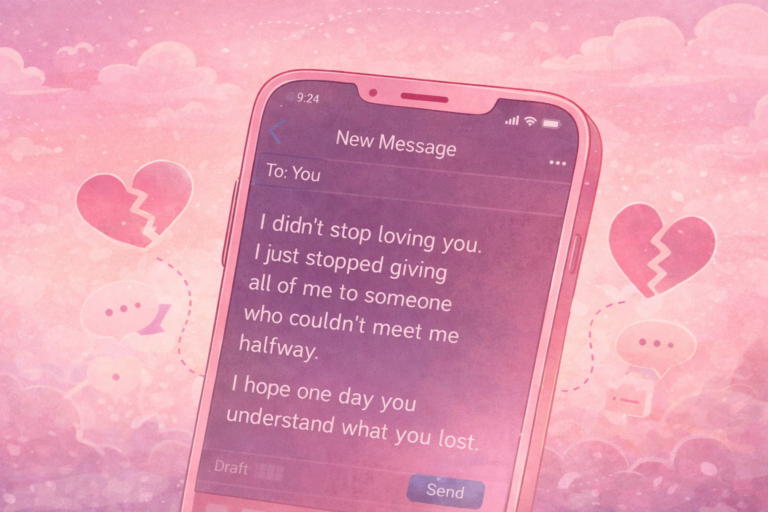

Some breakups end loudly.
There’s a fight, a betrayal, a final message that leaves no room for confusion.
But some end in a way that makes the grief harder to explain.
No slammed doors. No dramatic goodbye. Just a slow, painful awareness that something once full of meaning no longer has a place to live.
And that kind of ending can stay with you for much longer than people expect.
You can go to work. Reply to messages. Keep your life moving. You can look completely fine from the outside.
And still have moments where their name passes through your mind and changes the mood of the whole day.
That’s the part people don’t always understand.
They think heartbreak is supposed to look obvious. Fresh. Messy. Immediate.
But sometimes it looks like functioning.
Sometimes it looks like making dinner, folding laundry, answering emails — all while carrying a quiet ache you can’t fully explain to anyone.
It is hard to move on from something that once felt like home
I think that’s why certain breakups stay in the body for so long.
It isn’t always about wanting the person back exactly as they were. Sometimes it’s about missing the version of life that existed when they were still part of it.
The routine. The small check-ins. The sense that someone knew the shape of your day.
Even when the relationship had problems, there was still familiarity in it. A rhythm. A private world.
When that disappears, the loss is not only romantic. It’s practical. Emotional. Personal. It leaves little gaps all through your day.
That’s why people can feel confused by their own grief.
They think, But I know why it ended.
Or, I know it wasn’t right in the end.
Or even, I’m not trying to get them back, so why does this still hurt?
Because understanding something is over is not the same as emotionally being finished with it.

Some endings do not leave cleanly
I think this is especially true when the relationship mattered in a quiet, ordinary way.
Not just in the big moments, but in the daily ones.
The person you would message first. The one you would tell random nonsense to. The one tied into your habits without you even noticing it while it was happening.
Once that becomes absence, the mind does strange things.
It circles back. It revisits. It reaches for something that is no longer there.
And because there is no visible wound, people expect you to be “better” much sooner than you actually are.
That can create a second kind of pain.
Not just heartbreak itself, but the pressure to be over it on schedule.
To have become wise from it already. To speak about it neatly. To act as though time has done its job simply because enough of it has passed on the calendar.
But that’s not how it works for everyone.
Some people leave, and the relationship goes with them.
Other people leave, and something stays behind.
Missing them does not always mean you made the wrong decision
This is another part people struggle with.
They think missing someone must mean the breakup was a mistake.
I don’t think that’s true.
You can miss someone and still know the relationship was not right for you.
You can love someone and still know you could not keep living inside the version of the relationship that actually existed.
You can move forward and still feel the pull of memory.
Those things can all be true at the same time.
Sometimes what lingers is not the relationship itself, but the unfinished emotional shape of it. The way it lives on in your habits, your memories, your sense of who you were while it was still happening.
That is why so many people end up asking themselves the same quiet question long after the breakup is technically over.
Why am I still carrying this?
Why am I still thinking about them?
Why does this still have a hold on me when I’m doing everything I’m supposed to be doing?
If that question has been sitting with you too, this piece on why you’re still not over your ex explains it in a way that feels honest rather than clinical.
Maybe the hardest part is how invisible this kind of grief is
You can’t always point to a dramatic event.
You can’t always explain it in one sentence.
It just shows up in odd places.
While driving. While making coffee. While hearing a phrase they used to say. While looking at your phone for no reason at all.
And for a second, the past becomes present again.
I think that’s why people can feel frustrated with themselves. They assume grief should behave better by now. Be quieter. Be more obedient.
But heartbreak is not always loud.
Sometimes it is just stubborn.
Sometimes it sits beside you while you go on with your life.
Not ruining it. Not taking over it completely. Just reminding you that something real happened, and that real things do not always leave on command.
Maybe that is the gentler way to look at it.
Not as failure.
Not as weakness.
Just as proof that some connections take longer to loosen than other people realise.
And maybe healing is less about forcing yourself to feel nothing, and more about slowly building a life that can hold the memory without collapsing under it.
That is quieter work. Slower work.
But it is still movement.