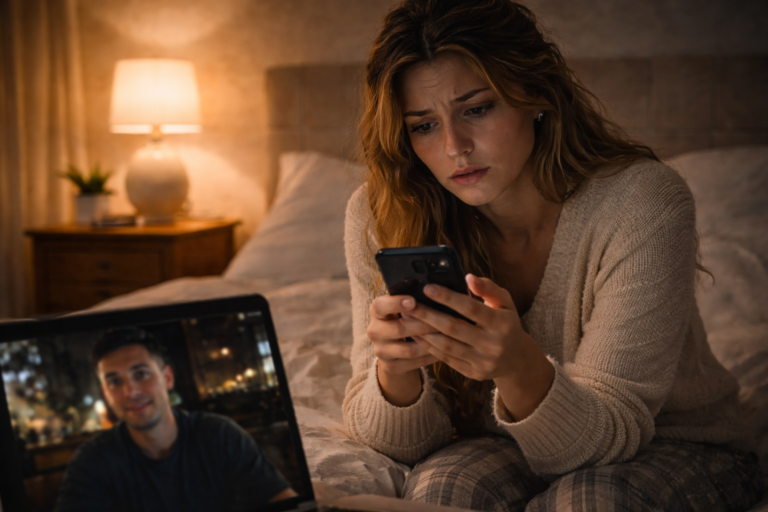

I Thought the Cheating Would Be the Worst Part. It Wasn’t.
I used to think that if someone cheated on me, the worst part would be obvious.
The cheating.
The other woman.
The lying.
The humiliation of knowing that while I was living my normal life, something else was happening behind it.
I was wrong.
The worst part was what happened afterward.
It was looking back at perfectly ordinary memories and wondering which ones were still mine.
It was remembering a dinner we had and suddenly wondering whether he had messaged her from the bathroom.
It was remembering a weekend away and wondering whether he had already met her by then.
It was remembering how distant he had seemed for a few weeks and realising that maybe I had noticed more than I gave myself credit for.
Cheating did not just damage the future.
It contaminated the past.

I started replaying everything
There were things I had ignored because I did not want to become suspicious.
He was tired.
He was stressed.
Work was difficult.
He needed space.
His phone was suddenly always near him, but I told myself not to be ridiculous.
He seemed emotionally elsewhere, but I blamed myself for being needy.
Looking back, I could see why people become obsessed with finding signs that a boyfriend is cheating.
You want the past to become obvious.
You want to be able to point at one moment and say, There. I should have known.
But real life is rarely that neat.
People who love someone usually do not begin from suspicion.
They begin from trust.
I blamed myself for believing him
This was one of the ugliest parts.
I kept asking myself how I could have been so stupid.
Why did I believe that explanation?
Why did I not check?
Why did I let him reassure me?
Why did I accept that he was just going through something?
But eventually I realised something important.
Trusting your partner is not stupidity.
You are supposed to be able to trust the person you share your life with.
The shame belongs with deception, not with the person who believed the deception.
Then I became obsessed with her
This surprised me.
I thought all my anger would be directed at him.
Instead, I found myself thinking about her constantly.
What did she look like?
Was she younger?
More attractive?
More confident?
Did she make him laugh more?
Did he tell her things he stopped telling me?
I was turning her into an answer.
If I could work out what she had that I did not, then maybe I could understand why he cheated.
But comparing yourself to the person your partner cheated with is a trap.
It quietly turns his choice into your failure.
If you are doing this too, this piece on how to stop comparing yourself to the other woman explains why the comparison feels so compulsive.
The affair was not a beauty contest.
I did not lose because she won.
I still loved him, which made everything worse
This was the part I felt most ashamed of.
I still wanted him.
Even after I knew.
Even after the lying.
Even after I had cried so hard I could barely breathe.
Part of me still wanted him to sit beside me and tell me everything would be okay.
That felt insane.
How could the person who hurt me still be the person I wanted comfort from?
But attachment does not disappear because your brain receives new information.
You can hate what someone did and still love them.
You can want to leave and want them to stop you.
You can know something is unacceptable and still miss who they used to feel like.
If you are struggling with that contradiction, still loving him after he cheated does not mean you are weak.
It means attachment can outlive certainty.

I wanted him to regret it enough
I watched every reaction.
The tears.
The apology.
The panic.
The promises.
I wanted to see something on his face that would prove he finally understood what he had done.
But eventually I realised that regret is not just how upset someone looks when consequences arrive.
The more useful question is whether their behaviour changes afterward.
Does honesty continue after the immediate crisis passes?
Does accountability remain when you are no longer threatening to leave?
Does he answer difficult questions without becoming angry that you are still hurt?
That is why whether he truly regrets cheating is something you usually learn over time.
I could not stop thinking about it
For a while, cheating became background noise in my head.
I could be making coffee and suddenly picture them together.
I could be working and remember a specific lie.
I could be completely fine and then see his phone light up and feel my stomach drop.
The thoughts did not need permission.
They arrived when they wanted.
I kept wondering if thinking about it constantly meant I would never get over it.
But betrayal can create exactly this kind of looping.
Your mind keeps returning to the event because it is still trying to make sense of a threat it did not see coming.
If that is happening to you, being unable to stop thinking about him cheating is not unusual after trust has been broken.
I was terrified he would do it again
This became the biggest question.
Not whether he was sorry.
Whether I could ever feel safe.
He promised it would never happen again.
But promises sounded different after I learned he could lie.
I started paying more attention to patterns.
Did he become more transparent?
Did he still protect his phone?
Did he blame problems in the relationship for what he chose to do?
Did he minimise it?
Did he act as though one apology should have finished the subject?
If you are asking whether someone who cheated once will cheat again, look at what has actually changed, not only at what has been promised.
I realised staying and forgiving were different decisions
I used to think there were only two choices.
Leave.
Or forgive.
But there are more possibilities than that.
You can stay temporarily while you decide.
You can leave while still loving someone.
You can forgive and still decide that trust cannot be rebuilt.
You can remain in the relationship while forgiveness takes much longer.
You do not owe anyone a dramatic decision simply because they want certainty quickly.
And I stopped asking whether staying made me weak
People love simple rules about cheating.
If he cheats, leave.
Once a cheater, always a cheater.
If you stay, he will never respect you.
Other people say the opposite.
Everyone makes mistakes.
Don’t throw away years together.
You can work through anything if you really love each other.
Neither side knows your relationship better than you do.
The real question is whether the relationship can become trustworthy enough to live inside again.
If you are trying to work that out, whether a relationship can survive cheating depends much more on what happens afterward than on the simple fact that both people decide to stay.
The hardest thing was learning to trust myself again
That was the part I did not expect.
I thought healing would mean learning to trust him.
Instead, the first trust I needed to rebuild was my own.
I had to stop treating every instinct I had ignored as proof that I was foolish.
I had to stop believing his affair meant I was not enough.
I had to stop seeing the other woman as a verdict on me.
I had to believe that even if I made the wrong decision about staying or leaving, I would still be able to correct it later.
That mattered.
Because betrayal makes you feel as though you need to make the perfect decision immediately.
You do not.
If you are in the middle of this now
You may not know whether you want to stay.
You may not know whether you believe him.
You may not know whether what you feel is love, shock, attachment, fear or all of them at once.
You are allowed not to know yet.
What matters first is getting clear about what actually happened, what has genuinely changed, and what you need in order to feel emotionally safe again.
The broader cheating and betrayal relationship guide brings together the major questions that tend to follow infidelity.
And if you have only recently discovered what is happening, this guide on what to do when your boyfriend is cheating on you is a better place to start.
I used to think healing would mean forgetting.
It did not.
It meant reaching the point where what he did stopped deciding what I believed about myself.
Sources
Affair recovery: Exploring similarities and differences of injured and involved partners
Relational recovery after infidelity as a dual process
What determines forgiveness in close relationships? The role of post-transgression trust
Emotional processes following disclosure of an extramarital affair
An integrative intervention for promoting recovery from extramarital affairs